Welcome to Maid Spin, the personal website of iklone. I write about about otaku culture as well as history, philosophy and mythology.
My interests range from anime & programming to mediaevalism & navigation. Hopefully something on this site will interest you.
I'm a devotee of the late '90s / early '00s era of anime, as well as a steadfast lover of maids. My favourite anime is Mahoromatic. I also love the works of Tomino and old Gainax.
To contact me see my contact page.
Until very recently the consensus across most civilisations and creeds was that the heart was the principle organ of the body. Only in the last few centuries have scholars thought to move the "core" organ of life from the heart to the brain, but this sentiment has yet to permeate into the recesses of our collective mind; this is of course despite the word "core" literally meaning heart. The ancient Egyptians, during the process of mummification, would remove the base organs of digestion and store them in ceremonial canopic jars, while the worthless brain was liquefied, extracted from the skull through the nose and discarded unceremoniously. The only organ left inside the body was the heart, which was seen as the "seat of the soul" and the core of the body. Thus at the centre of every great pyramid sits a literal heart, embalmed in emanating layers of resin, bandage and stone.
Such ideas are much more natural to us than that of the brain as the pivotal organ: while the ivory towers may proclaim one truth, the vox populi often ignore them (which is of course vox dei). In parlance the heart remains the core, embedded into the phrases and symbols we use day-to-day, and remaining fundamental to our collective cosmology. This understanding of the heart as a symbol of the core extends beyond descriptions of anatomy. We understand the world through concentric loops of personification after all, seeing the shadow of a human form behind every object or construct we interact with. The hearth serves as the heart of a home, for a town the market, and for a country her capital. We naturally understand the world around us in such terms to allow us to harness our immense and innate powers of interpersonal empathy with objects not traditionally understood as animate. I believe nowhere is this seen moreso than in the world of mechanical engineering.
All creators naturally see themselves reflected in their creation: that creation is born of an aspect of themselves after all. Mechanics love their cars like children, as do computer scientists, heavy-machinists and bus drivers alike. Since time immemorial shipwrights and sailors have also understood their vessels as being in possession of some form of "personhood", with a distinct personality, idiosyncrasies, a name and even pronouns to match. It's easy to see why: complex machines feel alive. The rhythmic beating and undulations of pumps and pulleys which drive them, and the very biological image of wires and hydraulic hoses bundled together like nerves. On board ships it is a given that you treat your ship like she is alive. You must get to know her before you can feel safe around her, much like a wild beast: the little things which differentiate her from other hulls and make her tick. I occasionally have to give tours of my ship to visitors, and when explaining the function of various rooms onboard (we call them "compartments") I find the easiest method is to ascribe each location to a corresponding bodily organ. The bridge is the "brain" of the ship, where we can see out to the world most clearly and make quick decisions. Meanwhile the engineroom is the heart, being that beating core which provides power to all other functions and really gives each ship her "character". The sensors are the ears, the hull the skin, the HPSW system the arteries, the foul water plant the bowels. An interesting point to make in this regard is the architectural "centrepoint" of most ships, being the pelorus. A pelorus in the main compass repeater which sits at the centre of the bridge, allowing navigators to take readings of approaching vessels and points of land to assist in safe navigation. Ships are designed in such a way that when turning, the pivot point of the hull will line up exactly with the pelorus, allowing accurate measurements to be made mid-turn. In fact the pelorus itself has a corresponding design. The central pillar is topped with the compass dial, and on top of that a moveable telescope is placed; in order to view the compass bearing while also looking down the scope a crystal prism is placed along the barrel, reflecting the image of the compass into the eyepiece. As you pivot the telescope around this crystal must stay exactly in the same position to give a good image, which makes it the "centrepoint of the centrepoint": a ship the size of a city block all pivoting precisely around a lump of rock the size of a sugar cube. I'm unsure really what this would correspond to within my anatomic analogy: perhaps it is a Cartesian "seat of the soul", where the minds of the crew are most directly connected into the physical being of the ship. An anchor point between the relative world and the absolute.
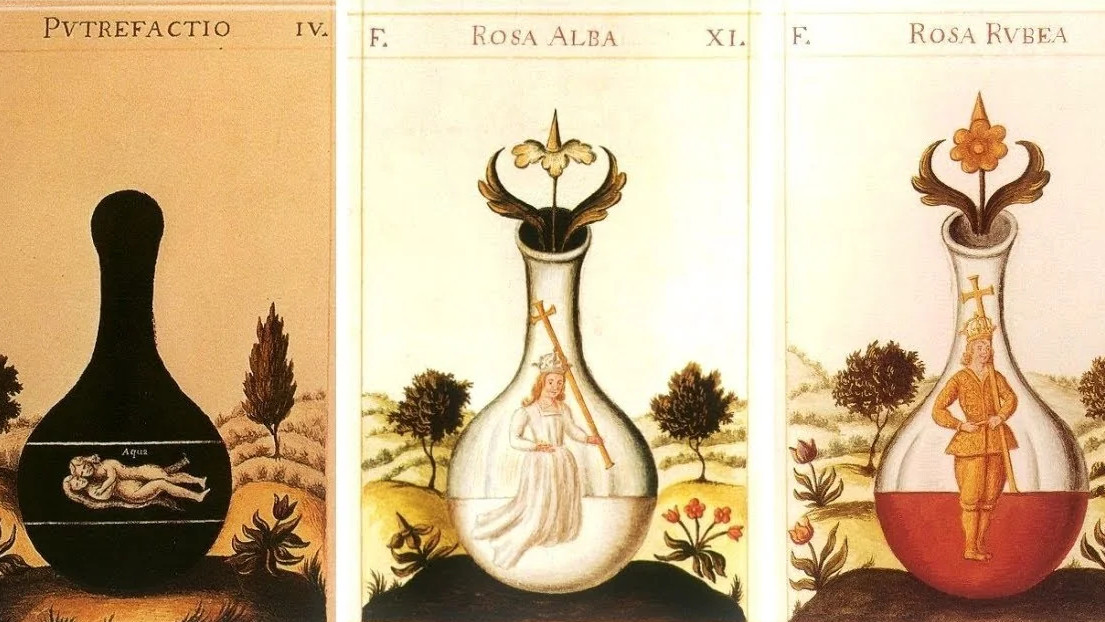
But to really create a machine which is "living" we must ascribe to it the gifts afforded to the living. The most simple and fundamental of such gifts is a name, thus elevating it in our minds to more than just a collection of base objects. In alchemical terms this moment of naming would be a "homunculisation": the birth of a lesser man through unnatural means, "created not begotten" as it were. Maybe such inclinations are innate to humans as a reflection of the nature of God the creator: to build a version of yourself in your own image and bestow upon it love above that which you might afford to any other possession.
Of course much of this can be construed as the wistful illusions of autistic men. The ancients write of Pygmalion, a sculptor of yore so skilled that he carved a statue so beautiful that he fell in love and married it. Today this story is usually a source of derision at lonely men, but when I read the tale as scribed by Ovid I feel within it a twang of wish-fulfilling jealousy. Pygamalion creates a being more beautiful and perfect than any natural person could ever be: he is able to make real his dream-maiden which so many men have wished to do for all eternity. In Ovid's version the Goddess Venus grants Pygmalion his deepest wish and breathes life into the statue, and the couple lead a happy life and even found the city of Paphos on Cyprus. It's a fantasy which I'm sure all men (and I assume women) think up at some point, but its one that we also understand as being a sinister upwelling: a dark fantasy which should never be attempted for real. Such mires of delusion are easy to drown within, and when your goal requires divine intervention from Aphrodite herself, its scarcely one worth pursuing.