Welcome to Maid Spin, the personal website of iklone. I write about about otaku culture as well as history, philosophy and mythology.
My interests range from anime & programming to mediaevalism & navigation. Hopefully something on this site will interest you.
I'm a devotee of the late '90s / early '00s era of anime, as well as a steadfast lover of maids. My favourite anime is Mahoromatic. I also love the works of Tomino and old Gainax.
To contact me see my contact page.

After reading my friend's article on the topic a few weeks ago, and having seen it a lot in towns along the South Coast, this weekend I visited the epicentre of the "flagging epidemic" in South Birmingham. The context for foreign or otherwise unaware readers: various parts of England have been experiencing spates of not-so-violent vexillological vigilantism over the last month or so, with semi-organised groups hoisting the Union Jack and St George's Cross up lamp-posts with cable-ties and a ladder. The movement started in South Birmingham, but has at this point spread across the nation being seen in neighbourhoods, small towns and particularly along major roads across the country. The movement is conjunctive with the wider "Reformist" branch of English politics, figureheaded by Nigel Farage, although the actual "flagging" is almost entirely grassroots. This weekend I visited the origin place of the movement, a suburb of Birmingham called "Weoley Castle".
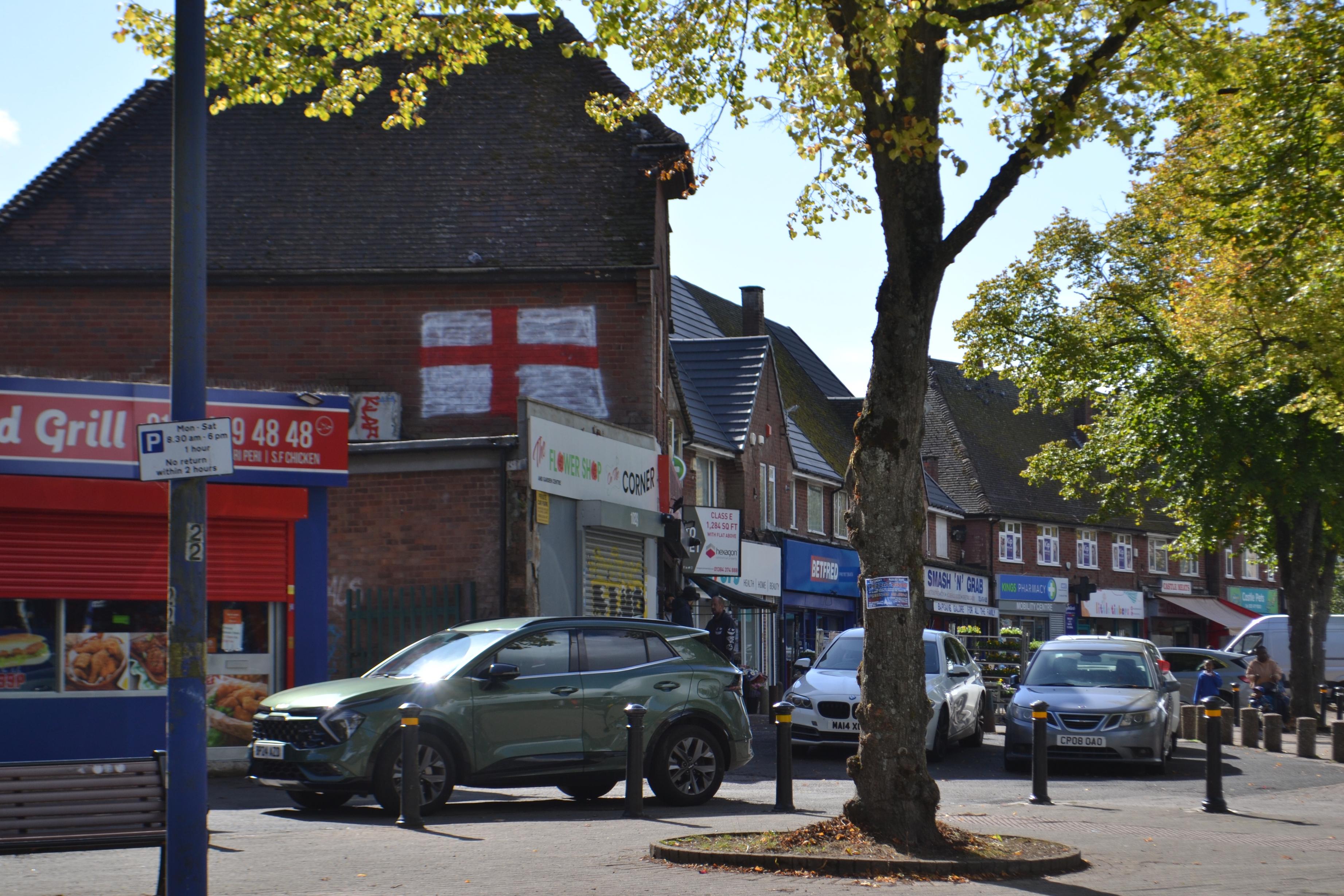
Weoley is, for starters, a largely unremarkable place. A hill-top village in Northeast Worcestershire that got subsumed by the grey mass of Birmingham and the Black Country in the 20th century to become one of countless suburban centres in the area. It is obscure even to Brummies at large, with Google Maps actually misplacing it when you search for it. The town has three real points of interest: the village green which acts as the focal point, with most of the shops facing onto it; the eponymous ruined castle to the north being the old seat of noble power made redundant by the industrialists and then being left to wrack & ruin; and finally the impressively large "Weoley Castle Pub" who's current festooning with flags gives it the aura of the likely house in which "operation flag" was first thought up. And my god are there a lot of flags. Every single lamppost in the district is flagged without exception; they line every street and cul-de-sac like they're hosting a royal parade. Yet more copies of St George's Cross are strung up in people's gardens, or hanging from windows, or even graffitied onto derelict brickwork. My first thought was one of recognition of the sheer effort put in here. While other examples I've seen around have been more haphazard and disorganised, in Weoley the totality was just impressive. There is something uniquely British about the exactitude on display here, a form of "almanacism". Every lamp-post in Weoley: no more and no less. The flags abruptly stop at the boundary of the next district, and along the primary boulevards Union Jacks and St George's Crosses take their orderly places in alternating fashion. An eye for detail one wouldn't generally associate with the genre of politics these people are likely from, but rather a village council aiming to win "Britain in Bloom". I've seen complaints (echoed by the BBC) that this is a symptom of our "Americanising culture", but this just isn't true. In America the stars and stripes are venerated, families ceremonial raise and lower their home's flag on a special flagpost, they don't ziptie them to lamposts every twenty feet. This is a British form of patriotic celebration, akin to hanging bunting or indeed like planting flower beds along the high street. Its much more like the (huge number) of national flags seen in the Nordic Countries like Norway, but that wouldn't make the point the BBC wants to make... These flags are apparently the sterling efforts of a group known as the "Weoley Warriors", a local faction describing themselves as:
A group of proud English men with a common goal to show Birmingham and the rest of the country of how proud we are of our history, freedoms and achievements. Giving hope to local communities that all isn't lost and they are not alone.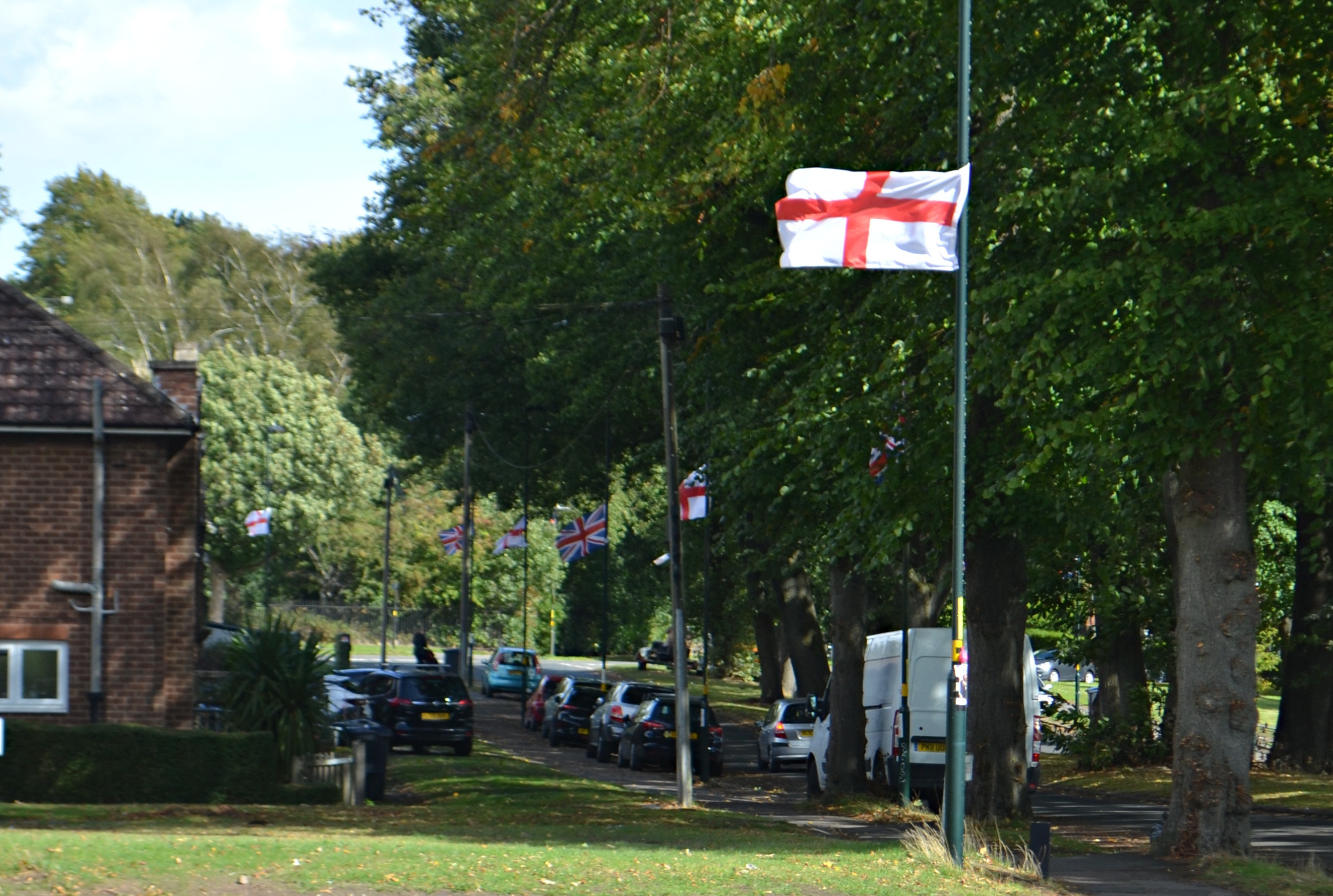
And while the group itself seems small and very homegrown, its hard to deny they have developed impressively charged "optics" which precede themselves. For most of England, the flags of Weoley have been seen through the lens of anti-immigration. A last-stand of the downtrodden English patriot pushed to the fringe of their city by encroaching masses; or a pathetic attempt at perpetuating racial division by football hooligans and unemployed thugs, pick your poison. "Weoley Castle" itself is an instantly enigmatic name for such a movement to spring from, a fortified redoubt flying their banner from her ramparts. From the crenelations of Weoley Hill you can see down onto the faraway towers of the Birmingham city skyline and the endless plain of suburbs stretching out for miles. Being high up, the wind blows strongly through the area giving the flags a strong flutter. Its a beautiful effect reminiscent of the old photos of national or imperial pride seen in Edwardian Britain. If one was to raise a banner in defiance, here would be the spot. In fact the throughline of this narrative follows the same as one of 20th Century England's most popular stories. JRR Tolkien grew up in a part of South Birmingham just a few miles East of Weoley in Sarehole, a place which through his younger life was transformed from a rural village into an industrial suburb by the encroaching smog of Brum's factories. Despite Tolkien's stubborn assertion that his stories contain no allegory, "Birmingham" and her sordid lust for growth and efficiency are the foundational evils of Sauron's war machine. The towers of Barad-Dur and Isengard were as the chimney stacks of industry expanding the black country of Mordor ever outwards... You still commonly see online Reactionary use of Tolkienian narrative as allegories themselves of their worldview: "the approaching orc hordes of the third world" et cetera. The City of Birmingham herself has collapsed into an object of ridicule, right-wing Americans probably believe it to be a literal lawless wasteland a la Mordor at this point (despite it feeling far safer and happier than many US cities I've visited but that's by-the-by). The council's recent bankruptcy, the police's inability to clamp down on grooming gangs, the bin-crisis leading to rotting waste in the streets and "rats the size of cats". Nothing good ever seems to come out of Brum as of late, so it doesn't seem mad for Weoleans to build up their defences.
In GK Chesterton's novel "The Napoleon of Notting Hill", the districts of London are spurred into ludicrous acts of regional pride by a lackadaisical King. They wear elaborate period garb, anachronistically wield halberds in the street, and decorate their streets with a multitude of colourful banners and flags. A walk down the streets of Chesterton's Notting Hill would surely be similar to a walk through 2025's Weoley Castle. The strange thing is that it is a self-fulfilling prophecy. The Weoley Warriors raise their colours because they think Weoley beautiful. And those colourful flags fluttering in the wind themselves do indeed make Weoley beautiful. My friend's article "Love as Patriotism" makes this point better than I can, but it is summed up in the Chesterton quote:
Men did not love Rome because she was great. She was great because they loved her.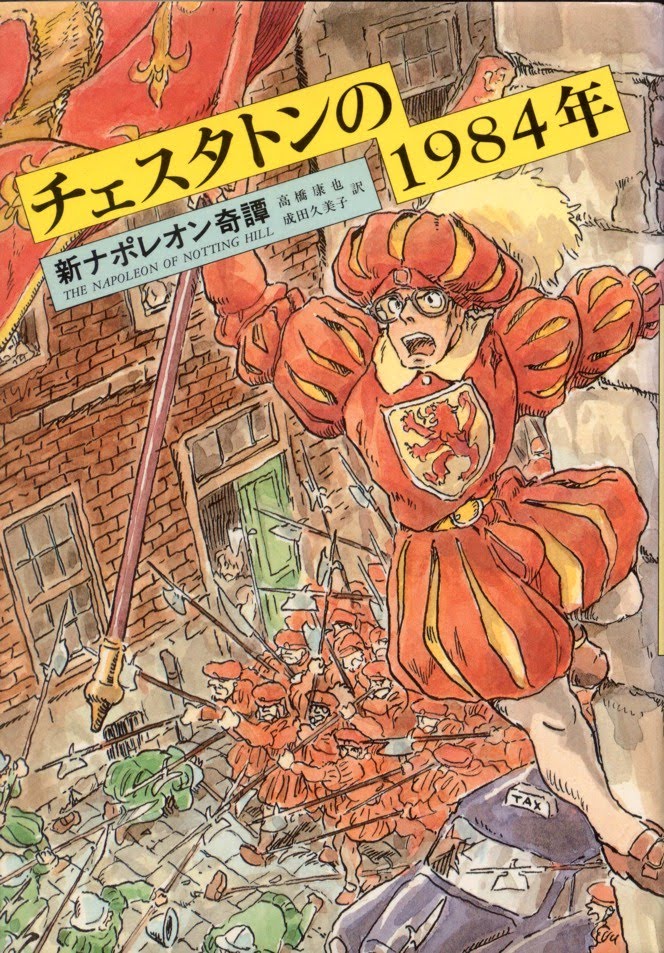 ^Japanese cover of The Napoleon of Notting Hill, illustrated by Hayao Miyazaki
And similarly to Napoleon of Notting Hill, once one district gets the flag-bug, it spreads to others. Across the country more flags than ever have been rising, in a country which is usually rather timid of any display of allegiance. I made this observation jokingly at first, but it does ring somewhat true: England is dividing into three worlds, the territory of which is marked out by three flags flying from every street corner.
As I wound my way through the twisting roads of suburban Birmingham I saw each of these Englands flash by in succession, in close proximity to one another but nearly never overlapping: their borderlands demarcated by their relevant flags. But while it may seem as though these are battlelines, trenches being dug for a coming conflict, on the ground it hardly feels that way at all. There is little inter-England violence between the three worlds: this isn't America. Violence is not an accepted form of persuasion nor a common symptom of political psychosis, unlike as it is coming to be for our New World cousins. There is just a very British ignoring of each other. We have found a way, usually subconsciously, of living our lives entirely within our selected England, never venturing into another, viewing them not with hatred but with mild fear and faux-ignorance. I'm the last few years (and literally yesterday which kind of undermines my point) we have seen occasionally clashes between the groups, although the great majority prefer to stick to their quiet grumbling. But its hard to deny the beauty of a place when her people love her, and Weoley's pride had me impressed. To end here's another, surprisingly liberal quote from the Weoley Warriors taken from their Facebook page:
A proud community is strong community. No matter your background race or religion we live side by side in this country together so when you look up and see the flags fly, they fly for you.