Welcome to Maid Spin, the personal website of iklone. I write about about otaku culture as well as history, philosophy and mythology.
My interests range from anime & programming to mediaevalism & navigation. Hopefully something on this site will interest you.
I'm a devotee of the late '90s / early '00s era of anime, as well as a steadfast lover of maids. My favourite anime is Mahoromatic. I also love the works of Tomino and old Gainax.
To contact me see my contact page.

On Thursday 30th January 2019 I had a dream, according to the dream log I have been sporadically keeping for the last decade or so. It was not a particularly complicated one, but the core idea of it has stuck with me ever since. This dream took place in some alternate England, where mankind lived up on the tops of the green rolling hills often seen south of the Midlands. The valley bottoms were, however, not frequented much due to a seemingly unabating fog that sat down there like slime, making passage difficult. Instead, ab immemorabili, the folk of this world had been constructing so-called "angel towers" to travel quickly between hilltops. These towers sat on prominent positions in the landscape, always with a direct line of sight to another tower: like war-beacons. By using "angel sight" one could magically transport yourself from one tower to another, bypassing the thick fog down below. I was shown how to use the towers in my dream, and (to weirdly quote myself) the description of the experience was thus: "I feel a magical energy pass through me and my vision is warped towards the second tower. I feel myself sprinting inhumanly fast towards the tower while my mind is filled with nature. It then decelerates and I have arrived at the other tower at an impossible speed." Within the framework of the dream the function of these towers seemed as reasonable as the sunrise, but even outside of the "mundus somniorum" I couldn't help but believe the notion was too natural to not have some larger truth to it. Here is a compilation of some interesting and relevant discoveries I have made in the years since.
Before that awe-some deluge which drowned the ice-age came through Northern Europe and swallowed the land which now lies beneath the North Sea, many of the great rivers of modern Europe were in fact tributaries of one mega-river than followed the course of what is now the Channel. The Thames, Seine, Rhine and Elbe (amongst others) all conjoined their flows into what was the largest river by discharge Europe had ever seen, meandering down the vast floodplains between England and France, eventually emptying into the Atlantic somewhere midway between Cornwall and Brittany. If the men of this era had any bearing on their geography (which incidentally I think they would have), one must assume that this river mouth was have constituted the furthest reaches of the world, the gate where the known meets the unknown. If you visit these two peninsulas today, you will find striking connections between them, especially in relation to prehistoric archaeology. Both are covered in vast numbers of monoliths and megaliths alike, clearly pointing to a shared culture and connection sometimes closer to each other than with the wider nation they are attached to. Additionally both places have a specific monument each which, for the purpose of this article at least, are emblematic of this connection: the two "Mounts of St Michael".
I am sure you already know of these two enigmatic places, as they feature on postcards and railway advertisements alike in both nations. But they bear striking resemblance to one another in not only name. Both are rocky islets sheltered in bays, with tidal causeways connecting them to the mainland for only several hours each day. Both were the sites of early Christian monastic settlement, and both were dedicated to the Archangel Michael. Both have churches built atop them, in architectural styles to correspond perfectly with their respective nation. One can draw a straight line between the tallest towers of each church without obstruction, although their distance is too great so as to see one visually from the other.
The other such "gate where the known meets the unknown" in, more famously, the strait of Gibraltar. Here, the Greek myths claim, Hercules split the isthmus which connected Europe and Africa, connected the Mediterranean with the Atlantic for the first time. He then placed down two great pillars to demarcate this as the edge of the world, and today we know them as the rocks of Gibraltar and Ceuta. These two have similar striking similarities to one another as the previous two did. Both are very prominent limestone mountains, connected to the mainland only by thin, low-lying banks. Both are exclaves controlled by "the wrong state", with Gibraltar being (correctly) British but surrounded by Spain, and Ceuta being Spanish but surrounded by Morocco. And, increasing the sense of connection to the other side, Gibraltar is the only place in Europe with wild monkeys. I have a lot more to talk about with respect to Gibraltar, so I'll be writing an article dedicated to her in the future, along the lines of my previous article about Puerto Rico. When I first visited Gibraltar last year, I was intrigued to discover that this rock too had connections to St Michael. An interesting church on the main street has a trifold-dedication reflecting the three branches of the British Armed Forces in some weird version of the holy trinity: the Army's King's Chapel, the Navy's Trinity Chapel, and the RAF's St Michael's Chapel. But more prominent is St Michael's cave, found half way up the southern side of the rock itself. A natural expansive cavern system, these caves are truly a place of beauty, with a truly amazing display of stalagmites and tites. These caves have not yet been fully mapped out, as some parts have been collapsed in over the centuries, but "some say" that there exists a route which extends beneath the strait and emerges out in Ceuta, providing a route by which various tales have either the Muslims or the monkeys arrive into Europe via. However, while St Michael is surely important to this theory, Gibraltar itself is actually named for another angel. Translated from Arabic through Spanish to English, the name means "Mount Jibril", with Jibril being the Arabic name for the Archangel Gabriel.
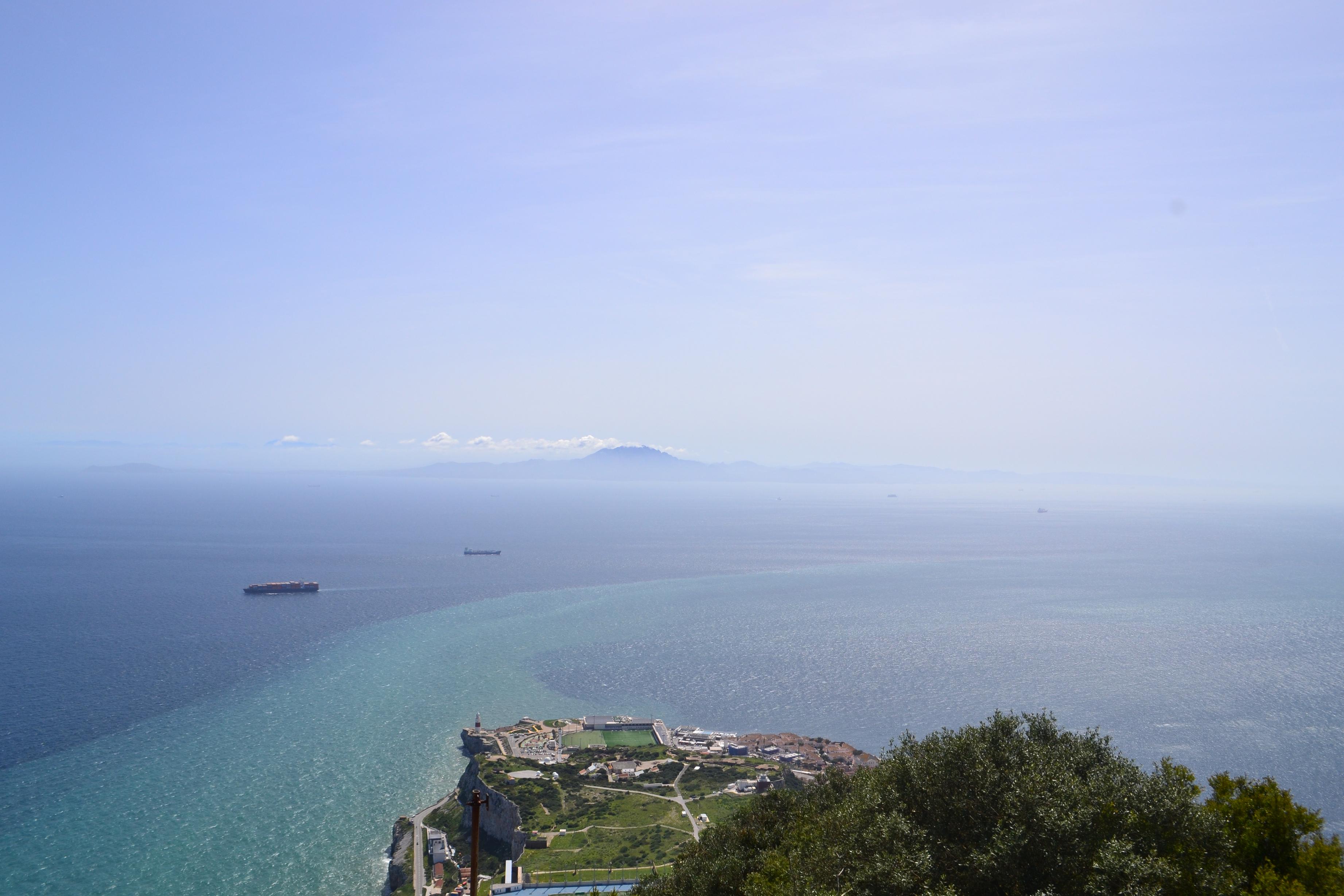 ^A photo I took from the summit of Gibraltar of Africa. Ceuta and her isthmus can be seen on the left.
While these are the most prominent two pairs of "angel towers" I have encountered, there are more. Looe Island, for example, is also situated along the Cornish coast and may provide a secondary link to Mont St Michel. Dedicated to St Michael since the early Mediaeval period, Looe island is where it is said Joseph of Arimathea landed with the Christ Child (surely a story for another time) and it even has a (very loose) connection with monkeys too (the connection between monks and monkeys is poor to begin with). Skellig Michael is an islet off the farthest flung Western coast of Ireland, now famous for being that island Luke exiles himself to in the new Star Wars. But it was again a place of deep-monkery (actual monks this time), and it is the point in Europe which is closest in proximity to the American continent, which would be quite the shortcut. And although I generally think them to be discredited, it would be amiss of me at this point not to mention (hushed voices please) "leylines". For the uninitiated, "leylines" are a concept developed in Britain by the Arts & Crafts movement in the 1920s to explain the seemingly inexplicable phenomena of important spiritual monuments being built in perfectly straight axis across extreme distances of thousands of miles. In England we have "St Michael's Alignment", plotting a straight line from St Michael's Mount through Glastonbury Tor through St Edmundsbury Cathedral. Over Europe we again have "St Michael's Sword", plotting over Skellig, both mounts of St Michael, St Michael's Abbey in the Alps (pictured below) and further on to various other angelic locations across Europe and the Near East. [Click here to see a map of both these lines] Having been an obsession of mine in the covid era, I must begrudgingly admit that it has been "proven" through statistical analysis that leylines do not exist. They are (probably) merely a product of our minds seeing patterns where they don't exist (although as an aside, a common "gotcha" is that leylines are only straight on a map, not on a globe, but they are in fact "rhumb lines", not "great circles" and if you don't know what that means you shouldn't be faking any sort of cartographic prowess over anyone). However the fact that they so often have St Michael at their centre makes me think the connection isn't invalid.There's something about St Michael and straight-line connections with distant places that is true, I'm just not sure what the source of this is yet.
 ^St Michael's Abbey, the Italian Alps
Overall to me this is a fascinating subject which I have been struggling to pry open for years, it feels like something so natural but yet ridiculous. These supernatural connections between places connected through history and geography, woven in with the mysterious power of angels which I'm sure not even the most learned theologian really understands. A mystery which feels like it extends back into the deep mists of time, but mankind has only ever been cognisant of it at the surface-level, if anything our appreciation of it has regressed. I will surely continue to do research on the topic in the years to come.
PS: This post is the first made for the now revised "Blogging Derby" in which Maidspin, BreadIsDead and newcomer the KnowNotWhere Gazette will be publishing an article every week until only one is left standing.