Welcome to Maid Spin, the personal website of iklone. I write about about otaku culture as well as history, philosophy and mythology.
My interests range from anime & programming to mediaevalism & navigation. Hopefully something on this site will interest you.
I'm a devotee of the late '90s / early '00s era of anime, as well as a steadfast lover of maids. My favourite anime is Mahoromatic. I also love the works of Tomino and old Gainax.
To contact me see my contact page.
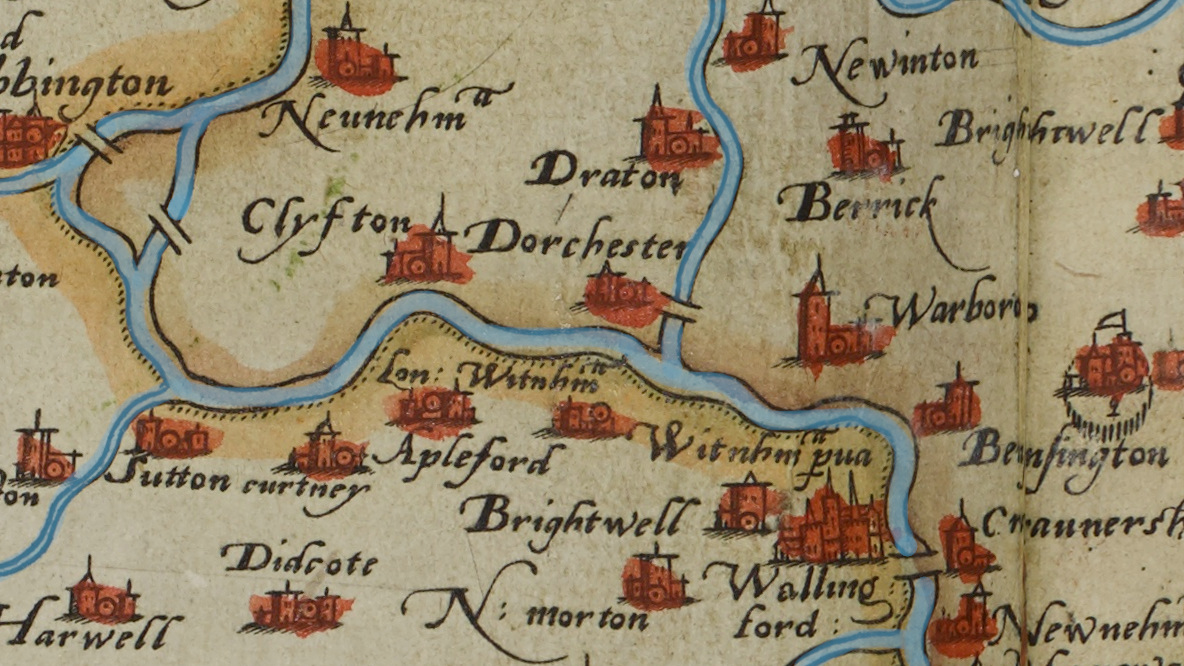
The great rivers of the world have always fascinated me. Along with coasts and mountains they act as the principal dividers of the land, but also as natural connecting nerves along which people and ideas can flow. In England there are several such rivers, the three longest of which can be found in middle-England: the Severn, the Trent and the Thames. Each of these three splits up a large part of the country between their watersheds (the area of land that drain into them), carving out distinct culturo-economic regions. These are broadly: the Severn and the Mercian Marchlands; the Trent and the Danelaw Boroughs; and the Thames and Saxon Home Counties. Despite being the shortest of the three, the Thames is (arguably) the most important river in England with it playing host to our capital and being the closest major river to the trade of Europe, so its path has always interested me, particularly the the minor locales upstream of the metropolis.
In my adult life I have made the strange decision to work in a career that requires me to be on, or at least close to, the sea, particularly on the South Coast. This is despite having always lived and having all my connections in the realms of Severn-Trent literally as far from the coast as is possible in Britain. Therefore I often find myself making long drives from the southern port-cities into the interior, or at least long in a European context (that is 2-3hrs rather than Americans' 10-12). For me that is often too much, so I stop off enroute to explore some intervening point of interest I've never been before; and luckily there's a lot to see in that part of the world. Naturally this route will always take me across the River Thames, usually around the major crossing point of Oxford. One time in Oxford I talked to a guy about the upcoming "Summer Eights" boat-race and he told me that it would be taking place "on the River Isis". I have always thought Oxford sat on the River Thames, but apparently this isn't the case after all. According to tradition, the upper reaches of what is scientifically speaking the Thames are in fact known as the "Isis" until they meet with the waters of the River Thame (different than Thames) some dozen miles downstream of Oxford, hence the old name of the river "Thamesis": Thame-Isis -> Thamesis -> Thames.
A few weeks back I saw the opportunity to take a detour from my commute home and visit this interesting locale at this confluence of the Isis & the Thame, nearby to the village of Dorchester (which is not to be confused with Dorchester, Dorset). It's a picturesque little village, but one with outsized historical importance fundamentally owing to its very location at that confluence. The area has been inhabited since before the Bronze Age, and seems to have been of religious significance to the preroman pagans (although it is an odd "coincidence" that so many places nearby to the Oxford antiquarians are denoted as such). I started my exploration at some major earthworks around the river's confluence, three hills called the "Wittenham Clumps" so heavily excavated and mounded upon that it is impossible to determine how much of them are natural and how much is man-made. The clumps rise commandingly out from the flat landscape, particularly the "Round Hill" as seen below (the other two are called the "Castle Hill" and the "Barrow Hill"). Collectively this area has archaeological evidence placing its habitation to at least 3000 years ago during the Bronze Age, but probably far earlier too.
 ^ The Round Hill Clump
The clumps sit on the southside of the river (in what was traditionally Berkshire but has recently been given to Oxfordshire); but as bronze gave way to iron the residents moved north of the river to where Dorchester village is today. As this "chester" name implies it was a Roman fort, and large earthworks of that era still scar the alluvial landscape being used today as sheep-pens, with the modern village built atop Roman foundations. After the Caesars left and the Anglosaxons invaded, the river Thames/Isis would become the border between the realms of the Saxons and Angles (Wessex & Mercia at this point in particular), with the town itself being passed back-and-forth between the two Kingdoms several times over the centuries. As you cross the river onto the Oxford-side and pass between the Roman earthworks, you will soon reach the confluence itself. The wide and sluggish Isis is conjoined by the meandering and considerably smaller Thame. There's something special about river confluences, where two bodies of water merge seamlessly into one. It was at this exact spot which, in 634AD, Saint Birinius would land after sailing up from London & Canterbury to meet with the heathen King Cynegils of Wessex as he was on campaign against the Mercians. After telling of the great victories King Oswald of Northumbria had achieved after his conversion, Birinius eventually persuaded the King to be baptised alongside his royal entourage in the river here at this confluence. And with the House of Wessex being the royal line which would eventually unify England under Alfred, this is the moment at which the current bloodline of the British Royal Family were first baptised to Christ, making this sport quite special. King Cynegils gifted St Birinius the town of Dorchester as a base for his episcopy, a diocese which rather obnoxiously covered the entirety of Wessex AND Mercia, in a transparent effort to align the expansion of the church with the expansion of his domain. From the very beginning entwining the church and state (as you can read about here!).
Dorchester would grow into one of the first true "cathedral cities" of England, with the seat at the newly built Dorchester Cathedral. Much of the original Saxon architecture has since been destroyed, but the extant Dorchester Abbey is still a huge twin-naved Normanesque church which contains the shrine of St Birinius himself, rebuilt shortly after the Norman invasion. At some point the power of the Mercians grew stronger than that of the West-Saxons, and Mercia gained control of the town, with Wessex moving their bishop down to Winchester. But at this time Dorchester only grew in importance as trade started to grow between the various kingdoms of England, with Dorchester becoming a principal stopping point between London and Oxford. The Abbey became highly enriched by this trade, growing into an important ecclesiastical centre with a vibrant monastic life.
However, the only passage across the river here is via a small footbridge, which points towards Dorchester's primary failure geographically: the wide yet deep river channel which makes crossing here difficult. After William the Conqueror won the Battle of Hastings, he found himself repelled from crossing London Bridge by the forces of the Archbishop of Canterbury. So instead he took his army west along the Thames to find another crossing, which would not be for over 50mi until he reached the titular ford at Wallingford, just 2mi from Dorchester. Through the great reshuffling of society under the Normans, Wallingford would grow in importance with Dorchester losing out in turn. In 1085 Dorchester would lose its cathedral-city status outright, with the principal "See of Mercia" transferring to the mighty new cathedral at Lincoln. Dorchester's fortunes from then onward would only wane, with the abbey becoming less important and very much under the shadow of the growing colleges of Oxford. During the reformation in fact, Henry VIII used the income of the abbey to found Trinity College Oxford, although he thankfully refrained from desecrating the abbey having it become an (incredibly oversized) parish church instead. This moment really is the last entry into the annals of Dorchester's history, as nothing really seems to have changed here in 500 years. Most of the buildings haven't changed since that era, and if anything the population has decreased.
 ^ The Dorchester honesty shop.
And this sense of a place which has peacefully declined over 1000yrs is evident when you visit. The lack of any through traffic, the complex fields of allotment gardens, the sheep agrazing on the remnants of an ancient fort. Nothing new is happening here, that is except for one important thing: the birth of the Thames. Even as the eyes of men look away from Dorchester, the Isis and the Thame continue to meet one another in secret in this little corner of England, conceiving here the very life of London. Many a romantic Oxfordian has travelled out here after hearing of its historical importance, and in doing so felt compelled to muse poetically on what they have found. The figure of "Old Father Thames" is often used to personify the London portion of the river, but if in London he is an old Odin-figure with a scraggly beard and a missing eye, in Dorchester he is clearly just a boy nestled between the maternal mams of the clumps at the Christening font of England.
"That Isis, Cotswolds heir,