Welcome to Maid Spin, the personal website of iklone. I write about about otaku culture as well as history, philosophy and mythology.
My interests range from anime & programming to mediaevalism & navigation. Hopefully something on this site will interest you.
I'm a devotee of the late '90s / early '00s era of anime, as well as a steadfast lover of maids. My favourite anime is Mahoromatic. I also love the works of Tomino and old Gainax.
To contact me see my contact page.

This week Brian Wilson, the virtuoso behind the band "The Beach Boys", died. A leading figure in the music revolution of the 1960s, Wilson and the Beach Boys were America's answer to John Lennon and the Beatles. The story of the Beatles and the Beach Boys are intrinsically interlinked, with both bands developing a rivalry that pushed them away from their origins as marketable boy bands and towards progressively more complex and intellectual songwriting. Personally I enjoy both bands' songs, but can't help but view them as two sides of the same coin.
Both bands emerged in the early 1960s from the two polar ends of British civilisation. The Beatles from the endless dirty brick terraces of smokey old Liverpool, and the Beach Boys conversely from the fake green lawns and white beaches of California. But despite this disparity, both grew from garage bands playing in pubs and town-halls (and whatever the equivalent of those are in America) into the first true "boy-bands", surrounded by screaming girls and royalty-level paparazzi wherever they went. From their respective emergences in 1962, until the shift 1965 the world's eyes were on these nine young men, admiring eyes, envious eyes, lascivious eyes. And when I say "young men" I mean young; in 1962 the average age of the Beatles was 20 and the Beach Boys just 19. The two bands shaped the youth culture of the sixties, remolding the minds of the baby-boomer generation. For example, Wilson is the source of our current use of the word "vibes" from his song "Good Vibrations". They were maybe the first recognisably modern "super-celebrities".
This golden era of both bands ended in 1965 with the release of the Beatles' "Rubber Soul", in which Lennon & McCartney explore what "music" meant apart from popular conventions. The album is distinctively English, often calling on the immense emotion latent in "folk-music": that is music that has survived centuries through the potency of its depth lyrically, narratively, or more commonly and inextricably, "harmonically". It seems Brian Wilson saw Rubber Soul as a glove struck across his cheek, spending the next several months corralling his band, an orchestral army and his own mind to craft "something on the same level" as the Beatles, from which he begat "Pet Sounds", often cited as the greatest American album of all time.
Pet Sounds is a highly complex album, each song meant to be an exemplar of a different "philosophy of music production" as described by Wilson, such as "Wall of Sound", "Tone Colour Texturing" and other phrases impenetrable to the musically illiterate such as myself. Pet Sounds takes inspiration from a less ambiguous sources than the Beatles' work, developing a more modern form of music production and songs with a distinctively "American" sound, mostly untethered to folk. The exception to this is ironically the greatest track on the album, and what is commonly denoted as Wilson's magnum opus: "God Only Knows". It is said that upon hearing the record the McCartney declared the Beatles defeated, and to this day he cites it as the greatest song of all time. The song would go on to become Wilson's bottled moonlight: a ghost he would chase for the rest of his life, and which would drive him to madness.
The song is great. It manages to expertly extract that "latent emotion" from folk tunes I mentioned earlier into a grand but simple three minute song. I want to quote from Brian Wilson's autobiography here:
"I'm proud of lots of my songs, but "God Only Knows" is the one I'm most proud of ... I liked all those old songs that used rounds, like "Row, Row, Row Your Boat" ... I liked rounds because they made it seem like a song was something eternal. At the end of "God Only Knows," that's the feeling, that it could go on forever, that it is going on forever."For those unaware a round is a traditional form of song, most prominently from England, that involves the same tune being sung over the top of itself around a circle of several singers, forming a layered tune without the use of instruments. This inspiration from the English "Round" is evident when you listen to the track with isolated vocals, which you can listen to here, especially the slow fading refrain of "God only knows what I'd be without you," at the end in which the overlapping vocals create the "endless spiral" effect Wilson is attempting to put into words here.
And I don't want to pass lightly over his reference to the "children's song" Row, Row, Row Your Boat. An unassuming, modest tune we grow out of post-primary school, I have always had a soft spot for the song. During infant school we were made to sing it in rounds during music class, and the effect it had on me was strong. Such a simple and boring song, when sung in rounds, uncovers a hidden complexity of overlapping notes to create "chords" and a depth which is bewildering and feels impossible from the few notes of the song. To demonstrate this effect I want you to run an experiment. First sing the song to yourself alone... Unless you're a choirboy it probably sounded rubbish didn't it? But now listen to this version I found online by some random schoolchildren who I assure you are not "great" singers by any means. It's surprisingly good, right? (Or maybe I'm crazy). Brian Wilson evidently thought it was good too, but then again he was also probably crazy...
Somehow I am reminded here of one the final verses of Dante's Divine Comedy (Paradiso Canto XXVIII). Here Dante has ascended the nine spheres of heaven, finally reaching the "primum mobile", the Aristotelian "unmoved mover", the throne of God. Dante describes the sight as "great concentric gyres of angels", a myriad interlocking wheels of angels singing in harmony around the triple singularity of the Lord in high. In theology this vision is known as the "Empyrean" and is the closest known abstraction of the true vision of "God". I assume the chorus of cherubim and seraphim are not singing "Row Your Boat", but then again I do imagine the effect is similar. In this case the natural extremities of heaven surely mean it is the most simple of tunes, layered infinite times to create the most complex harmony possible. The song is unknowable, the sin of man makes it so; in fact maybe the purpose of life itself is to rejoin the chorus, or maybe "God only knows". Just as Dante and Tolkien alike described, creation was born of this "Round of God": sung for eternity as the core engine of creation itself. And maybe Wilson, just as Dante had all those centuries prior, managed to glimpse at the empyrean, and if he did he didn't escape unscathed.
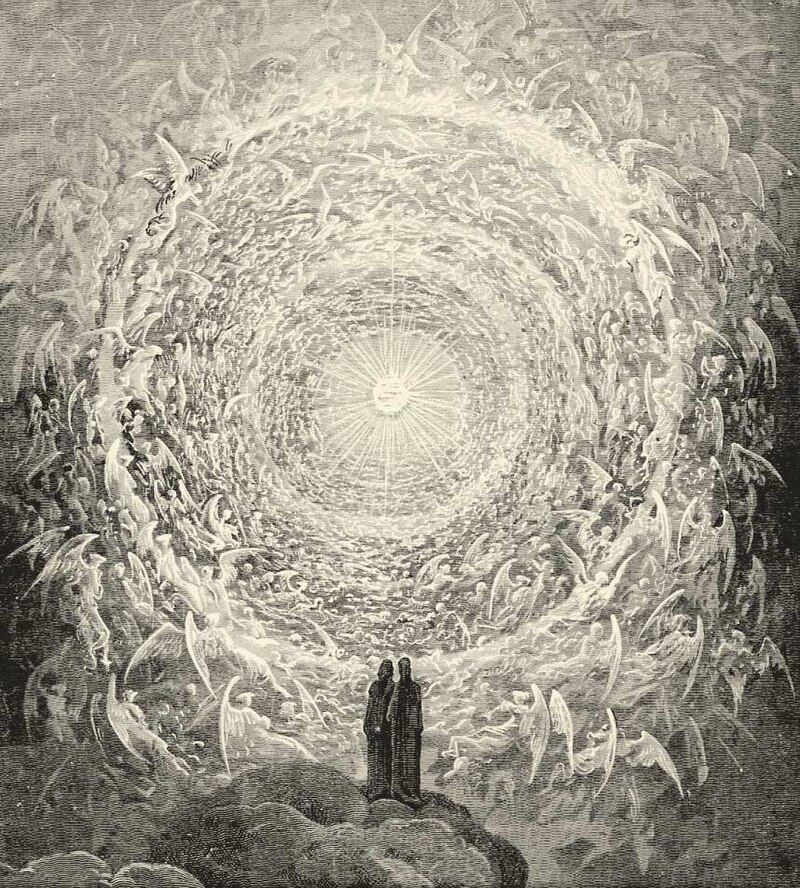 ^An illustration of Dante's Empyrean by Gustave Dore.
The years following Pet Sounds saw the Beatles release album after album of increasingly complex and beautiful songs. Wilson could simply not keep up. As both bands delved deeper and deeper into philosophical cave-systems fueled by a combination of new-age fervour and LSD, they both, almost simultaneously, entered a pupal cocoon stage, where neither band was seen for months on end. This psychological battle propelled Lennon to a godlike state, but conversely destroyed Wilson's soul. Musically the results were "The White Album" and "Smile". The former contains a plethora of bizarre and intricate songs which have been studied like high poetry for the last half century. The latter collapsed into its own grandeur and ultimately was never released, in turn destroying the Beach Boys as a cohesive unit and reducing Wilson to a shadow of his former self. For the next decade or so Wilson continued to chase the spectre of God Only Knows and "The Round", becoming obsessed specifically with the American folksong "Shortnin' Bread", which he claims to be the greatest song ever written. He insisted on playing the tune on loop at every occasion, ruining his relationship with his brothers, the band as a whole, and eventually leading to a self-induced madness and being placed into psychiatric care in 1975. Over the following decades Wilson went through periods of recovery and regression, releasing failed album after failed album, all of which are distinctively depressing in nature such as "Adult Child", a truly weird album containing several songs about paedophilia and even the "perfect" rendition of Shortnin' Bread. Wilson never managed to capture the magic of Pet Sounds again, but thankfully gave up on his Faustian quest in his later years, largely due to the shock murder of his rival John Lennon in 1980, and the drowning of his brother-cum-bandmate Dennis in '82. As far as I understand, Wilson lead a relatively peaceful and content latter portion of his life, dying last Wednesday aged 82. I hope he can at last take his place in the Round of Heaven. Rest in peace Brian Wilson.