
Welcome to Maid Spin, the personal website of iklone. I write about about otaku culture as well as history, philosophy and mythology.
My interests range from anime & programming to mediaevalism & navigation. Hopefully something on this site will interest you.
I'm a devotee of the late '90s / early '00s era of anime, as well as a steadfast lover of maids. My favourite anime is Mahoromatic. I also love the works of Tomino and old Gainax.
To contact me see my contact page.
For a certain generation of anime fans, the antics of Haruhi and the SOS Brigade are the defining otaku narrative. Just as the subculture was dominated in the '90s by Evangelion, Haruhi dominated the late '00s and early '10s with an utterly inescapable presence online, offline and anywhere around the globe otaku could be found. I recently had the once-in-a-lifetime opportunity to relive this bygone world at Aya Hirano's inaugural performance in England. She ran the full Haruhi nostalgia set to truly awe-some crowd engagement. The audience clearly consisted primarily of us "old fans"; the verging-on-thirty elite of the otaku scene (lol) who had dusted off their old North-High uniforms for a revival of an era long past. With the anime subculture as it is now, it was a great experience to be able to relive it if just for an hour.
Back in those days anime had a proper "canon", that is a set of shows which were required watching for anyone to be taken even remotely seriously. Of course this list shifted along with the times and community, but circa 2012 in the English-speaking West it consisted of anime such as Death Note, Toradora, Code Geass, Steins Gate, Cowboy Bebop and Haruhi; and maybe the Shounen Jump "Big 3". If you ever met someone claiming to be an "anime-fan" you could be almost certain they had seen the vast majority of these shows, even if they had opinions on them contravening the norm (in fact this was usually a given). This mentality has since died a sour death as the popularity of anime skyrocketed and the subculture fractured under its own mass into many smaller pieces, leaving no room for a collective common-ground. Even by 2016 the biggest shows such as Attack on Titan, One Punch Man or Tokyo Ghoul had far more controversial popularities, with many swearing off them altogether, and in the current era any such consensus expectation feels totally alien.
But the generations change in harmony with the world: its not like your average rock fan from the '70s would have much in common with one from the '90s after all, even if from the outsider's view they may appear similar. That's why as one moves from the decade of his teens to the next, he will naturally remain flocked with those who have come with him. When I meet new people I get on with in the anime scene these days (either on or off the web) they pretty much always turn out to be from a similar generation as me; that is they got into anime in 2010 +/-5yrs, with their actual age mattering little. And having such an accepted canon from that era is a great boon, an immediate point of connection and a broad enough catalogue to be able to quickly pinpoint their preferred genre. But while it won't be many people's absolute favourite show of that era, the Haruhi series forms the central pillar of "anime" or (in its original sense) "weeaboo" culture for my generation.
The reasons behind the Haruhi series' success lie within the pages of its story. Haruhi's juvenile rejection of "boring normality" and desire for something more from the world is parallel with how many of us felt at that time more broadly. The anime for me particularly was my gateway to a new world, being the first non-action anime I watched. I think "anime" fulfilled the same fantasy for us as the world of aliens, time-travellers and espers did for Haruhi herself. A beautiful delusion to dive into with that capricious vigour of youth which can only be tapped into by preternatural inspiration. The duo of Haruhi and Kyon form the internal dichotomy of teenage misdirected passion versus false disinterest which defines the peculiar condition of the teenaged spirit. Every highschooler wishes to live out their chaotic fantasies, but will also vehemently deny such urges externally until they can find an outlet for them: and for many of us in that time that outlet was the burgeoning world of anime, now accessible to 15yr olds in full for the first time ever (outside of Japan) via the internet. And I think the same spirit of the Haruhi series can be seen clearly in the innocent and charming era of the contemporaneous internet typified by lolcats, terrible anime art and a perverse number of songs about waffles. Haruhi is the apotheosis of the "lol so random" culture.
Perfectly hitting the zeitgeist with a piece of artwork is far from a science, and it's barely an art. Culture can propel the most unlikely of creations to the stars no matter its level of quality in a game of devil's chance. While Haruhi certainly had providence on her side when she took over the scene, the story is also crafted with a level of love and understanding for the classic axioms of storytelling that is quite staggering on a reread. Each subplot takes on a different genre of popular fiction in both a homage to the classics as well as a keen freshness and imagination. When I first watched through the show I was too young to have encountered the majority of the stories that the Haruhi series takes inspiration from, which I think was true for many of us (for instance did you know the format of titles are riffs off GK Chesterton's "Father Brown" mystery novels?). This highly concentrated serum brimming with the best of the tropes and cliches of the short-novel world is like ambrosia on a mind unclouded by deeper knowledge of such stories, hooking it like a drug and imprinting it into memory hard. To me Groundhog Day will always be an Endless Eight parody, and I will forever watch Back to the Future through the lens of Disappearance. As well as the plentiful Sci-Fi and mystery novel concepts introduced are the references (both direct and not-so) to the otaku world. The show is proud to sport basically every trope of 90s/00s anime possible. Whatever *dere you care for is accounted for, as is every fundamental of manga character design. Haruhi even has Mikuru model basically all of the core moe outfits of the ages, a personal inspiration of mine. For these reasons Haruhi is not just a "great anime" like some of the other shows I mentioned before are, but also an education and catechism into a new world.
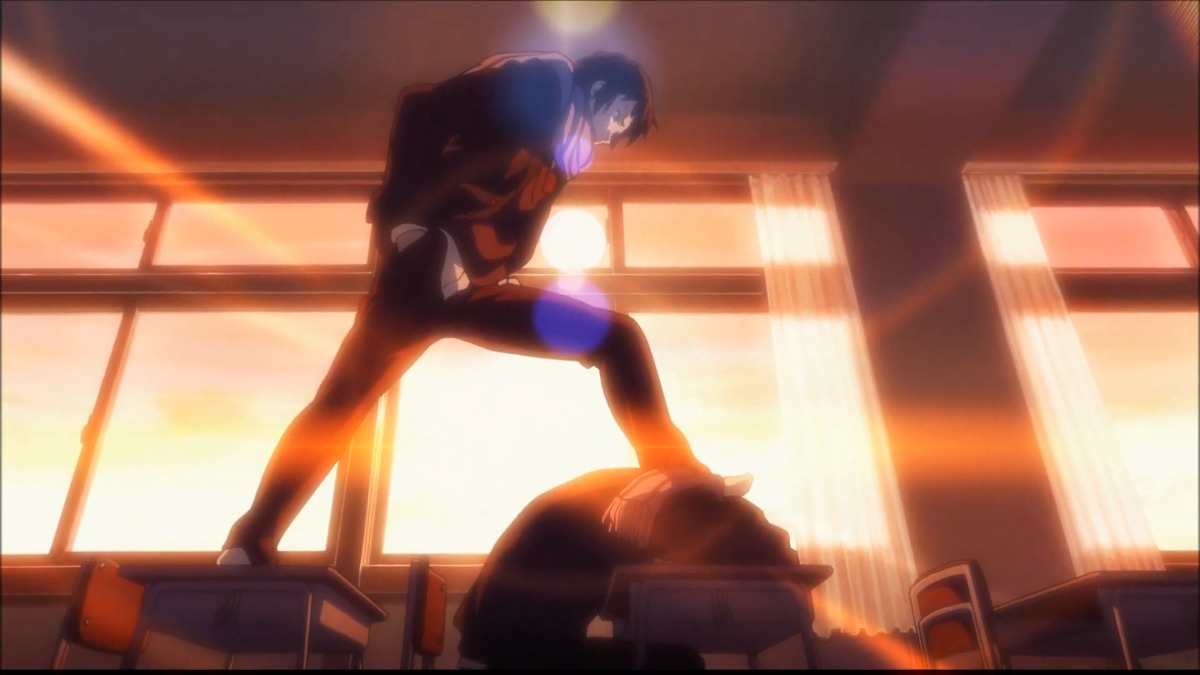
But it is built from the ground up as a meta story. It understands that it is an amalgamation of reference and parody as well as a love letter to the romance of youth, directing the passions of its audience. Haruhi is literally depicted as God, wielding such a power that the world itself is whipped into the shape of such teenage fantasies. This ingenious plot device makes everything both tongue-in-cheek and deadly serious simultaneously. The tropes are there because Haruhi wished for them; any criticism of their gratuitous use can inevitably be deflected off such a clever armour (at least in the eyes of the intended audience, which is all that matters here). It can therefore be seen that the overarching plot of the series is to remedy cynicism. The two sides of the teenaged mind I mentioned before find union here in sincerity. Kyon's projected cynicism crumbles under the will of Haruhi, and he is able to live the wild dream of chuunibyou-syndrome while keeping his cool, detached persona intact. This is explored in the Disappearance, as Kyon is forced to confront this internal incongruity and choose between the chaotic world of Haruhi's creation and the ease of Yuki's mundane highschool life. By rejecting Yuki he is able to shed those insecurities that damned many of our teenaged years to self-denying anxiety and live a youth without regrets: potentially the highest fantasy of all but of more potency than any sci-fi drama could muster.
The god-level renown garnered by Haruhi has fastened such immense importance to it for our generation of anime fans that for many of the hundred or so of us at the Aya Hirano concert it became a pseudo-religious experience. To hear in the flesh the voice of Haruhi Suzumiya herself (she even did some famous lines for us) felt like communion with a supernatural entity. The powerful connection with the crowd and wrought emotion in her voice let us live out a near perfect gestalt of the "God Knows" scene. I was able to live out for real a moment that was always meant to be fictional: for just a moment fantasy was made reality. This experience was so perfectly aligned with the plot of the series itself that it felt like an extension of the story itself. A nostalgic culmination, consummation even, of my youth: an experience I will be sure to treasure for a long time.
