
Welcome to Maid Spin, the personal website of iklone. I write about about otaku culture as well as history, philosophy and mythology.
My interests range from anime & programming to mediaevalism & navigation. Hopefully something on this site will interest you.
I'm a devotee of the late '90s / early '00s era of anime, as well as a steadfast lover of maids. My favourite anime is Mahoromatic. I also love the works of Tomino and old Gainax.
To contact me see my contact page.
The anime adaptation of "Kikai Jikake no Marie" (Anglicised surprisingly reasonably to "Mechanical Marie") is airing at a strange period in time. The story involves the young woman Marie coming into the employ of Arthur, the bastard heir to a large fortune, as his personal handmaid. Because of Arthur's succession crisis, he has become the target of (copiously) many assassination attempts and so has come to distrust all humans, instead demanding a robot servant to be his personal assistant instead. As a real robot-maid cannot be found, the already deadpan Marie is made to pretend to be a robot and serve Arthur as one. The story follows her attempts to keep this secret, while both become more and more attached to one another.
The anime is adapted from a manga series which ran in Shoujo Magazine Lala (which also ran Maid-sama) commencing in 2020 and concluding in 2023. The reason I bring this up is because the world's understanding of "robot assistants" has so massively shifted in the last 5 years that I doubt a story such as this could be told coherently in the same manner today. Open-AI launched ChatGPT in November 2022 and it came to global prominence early the next year, spreading to ubiquity over 2023 and igniting the current AI revolution. In 2020 "AI Assistants" hardly existed outside of terrible customer service bots and specialised technical search engines, but nowadays they are an inescapable part of our personal and professional lives, promoted heavily by every mega-corp in the world and utilised every day by everyone from primary-schoolers to pensioners. Just today you have probably either already had interactions with one, or (if negatively inclined) had to actively avoid one just in mundane usage of home/workplace technology. This several magnitude-fold increase in prevalence has pushed discussion on the ethics of AI to the forefront of popular thought, and many now hold nuanced opinions on such topics. These opinions are split, but the general sense of the zeit-geist is erring negatively critical of the corrupting nature of pocket artificial intelligence. Many scandals have arisen at the interface between the technology and existing legal frameworks, leading to lawsuits, damage and personal harm, all of which leave a sour taste in the mouths of those whose work, relationships and very livelihoods are being forcibly imposed upon by the steady forward march of technological progress. Just as the Luddites wanted the mills of the industrial revolution dismantled, many today wish the same upon the structures that enable AI proliferation. "AI cannot be trusted, nor can its enablers. It is a corrupting force which will spell disaster for humankind."
In Kikai-Marie Arthur wishes for a robot maid for very opposing reasons, he instead sees people as corrupt and untrustworthy, driven by greed, avarice and epicurean satisfaction. Meanwhile he sees robots as innocent of sin, following the strict axioms by which they are programmed and who are unswayable by selfish temptation. A robot maid would never betray him: it could never betray him.
Of course this dialectic over the morality of manmade life is one as old as time. The horror of unnatural life is one which I have discussed before. But I think the natural response to robotics has always been one of trust, its a machine that we can ostensibly extend full control over and micromanage its every thought and action after all. But this sentiment has been eroded by the limelight recently, with many more people displaying opinions of distrust or hatred towards the very idea of automation. In Japanese stories this has been particularly stark: robots in anime have usually been more on the innocent side than the corrupt one (Mahoro comes to mind) and robots have an important role in the "Japanofuturism" of the Heisei-Era, where the socioeconomic effects of an ageing and shrinking population are to be counteracted by robots and automation. However in the first few years of Reiwa the issue of "generative AI" has shifted opinions in the anime/manga sphere hard against such technologies, with pretty severe backlash and ostracisation for those caught using it for image generation and passing it off as original work.
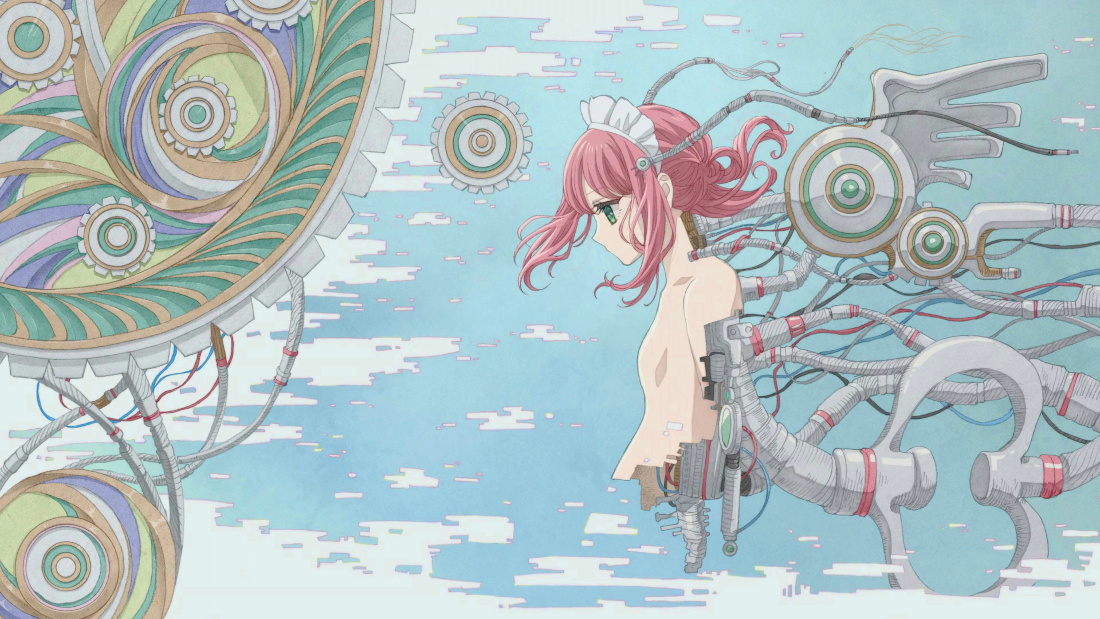
 ^ A stillframe from episode 1
In the first several episodes of Kikai-Marie we see several painterly still-frames (like the one above), used as punctuation in the style of Dezaki-sensei. Its a classic technique of limited animation, putting emphasis on an important scene without blowing out the budget. Although it is impossible to prove, and the mangaka has indeed suggested otherwise, many have identified some key evidence of AI generation within their creation, leading to backlash online. Due to the backlash, post episode 4 the production has ceased using them at all, which you can take what you will from. But whatever the truth is, this is a fascinating occurrence within such a show and is stark evidence of the changing image of AI. No longer are people able to praise the innocence of robots, but instead they weed them out and destroy them in retaliation for the degradation of society. Its hard to decide whether the robots betrayed us, or if we have betrayed the robots. This issue seems the stuff of science-fiction, but such a philosophical battle is at this very moment raging all around us and its importance only continues to grow as it pervades every space of society. Can we trust the robots?
At the core of Kikai-Marie is a lie. Marie is lying to Arthur in order to placate him and survive another day. As the audience we are in on the lie and view it with levity, but when that lie is switched on us we feel slighted. AI being used to create this anime in the pretence of being a human is basically the exact same situation that is portrayed in the show, and as we all know, lies beget lies beget lies. In Marie's case this escalates into more and more ludicrous situations as she attempts to keep up her charade, but in the case of the production it shifts into the altogether sourer realms of corporate cover-ups, scape-goating and shame culture. Although (probably) coincidental, this manifestation of the themes of the story in the reality of its production is evidence of the relevance of these stories. The continuing auteurship and individual nature of manga and LN publications mean that real-world issues like this can be tackled without the interference of soul-sucking committees or excessive time lapsing, keeping such works cutting-edge in a way corporate works can never achieve. Such "mimesis" goes both ways between art and life, but it also requires the complete sovereignty of the artist in order to stay "real".
