
Welcome to Maid Spin, the personal website of iklone. I write about about otaku culture as well as history, philosophy and mythology.
My interests range from anime & programming to mediaevalism & navigation. Hopefully something on this site will interest you.
I'm a devotee of the late '90s / early '00s era of anime, as well as a steadfast lover of maids. My favourite anime is Mahoromatic. I also love the works of Tomino and old Gainax.
To contact me see my contact page.
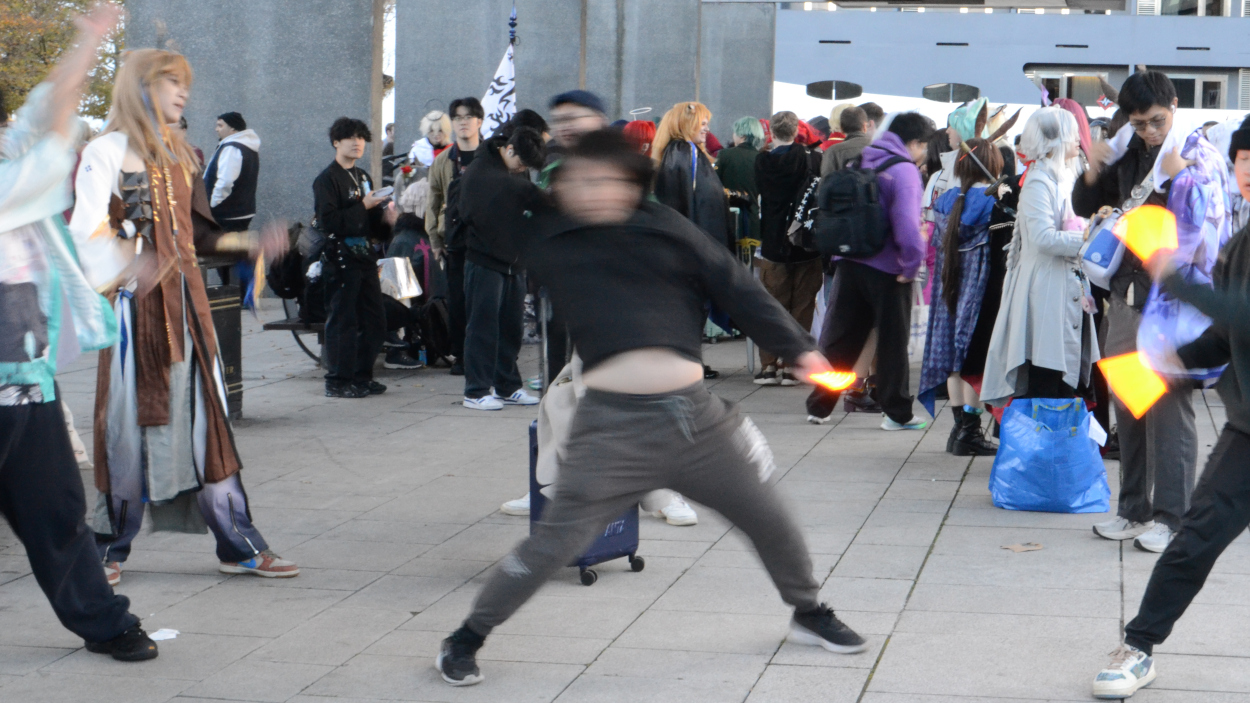
The "Anime Convention" is a common sight nowadays. Most countries have some annual event that can be classed as such, and in America and Western Europe they are multimillion-pound endeavours with tens of thousands of attendees. Some of the biggest in the West are London Comic Con at ~120,000 attendees; Anime Expo in Los Angeles at ~150,000 attendees; and the largest, Japan Expo in Paris at around a quarter of a million attendees annually. They've come along way from the grassroots hotel-based conventions of the 2000s, although that sort still exist today for more niche community events. Most mega cons today either grew out of smaller groups or (more typically) grew to so great a faction within more general "nerd cons" that they eventually make up a majority and take over. Which incidentally is what happened to my university Sci-Fi Society too. Maybe the "anime is cancer" guys from 10 years ago had a point...
But while for modern cons Britain may be on the smaller end compared to America of continental Europe, we have the distinction of holding the first ever. At least the first ever convention for Japanese culture. Building up over the 19th century until the outbreak of the Great War, "world exhibitions" were all the range. Probably the most famous is the 1851 Great Exhibition in London (as starring in the anime "Emma"), famous for the Crystal Palace and laying the foundations for the Albert Hall and the Natural History Museum. There's also the 1889 Paris World Exposition (as starring in Nadia Secret of Blue Water) for which the Eiffel Tower was built, and the 1893 Chicago World's Fair which I'm sure was great but its never been in an anime so I don't know anything about it. By the turn of the 20th century, world fairs had become one of the main stages upon which the world's great powers could show off to each other in the absence of war during the long "Pax Britannica" of "La Belle Epoque". In this time as the newly opened Japan industrialised her economy she wanted to get in on the action to claw herself up to an equal footing with the European powers. Japan, however, was still seen as a far flung and poor corner of the globe, and the Japanese Government knew an event in Tokyo would struggle to attract the European and American guests they wanted. Therefore they approached the country with which they had the closest ties with in that era, Britain, to arrange a joint Japan-British Exhibition in London.
 ^Poster for the Japan-British Exhibition
The Exhibition took place over the Summer of 1910 at a large campus in "White City" just west of Kensington, which at that time was the go-to place for such events with a large open field and a specially built tube stop for the many visitors. It ran all-in-all for 168 days, garnering an estimated footfall of over 8 million including King Edward VII himself and the majority of the Britain's great and good. While named the "Japan-British" Exhibition, the event was developed almost entirely by the Japanese with only a small contingent of British exhibitors. These exhibits primarily consisted of scale dioramas of traditional Japanese buildings, all fitted with actors ready to illustrate the Japanese arts such as calligraphy, weaving or steelworking. A mock Zen Temple was constructed along with accompanying garden and tea-house for visitors to explore. Various Japanese performances were given, such as Noh Theatre or instrument playing, as well as sporting events including the first ever sanctified Sumo bout fought outside of Asia (coincidentally the most recent such bout was also in London, held in the Albert Hall last month). The Japanese state seemed keen to portray themselves in line with what they thought were "British Values", which included exhibiting Ainu, Korean and Formosan men to push the idea of Japan as an imperial power with subservient subject nations. These turned out to be a miscalculation and were seen as cruel by many of the liberal-leaning British (and Japanese) elite and were subsequently removed.
The modern western con unfortunately cannot claim an apostolic succession from the 1910 Exhibition, only a spiritual one. Rather they are more sensibly an amalgamation of American superhero-comic focused events of the 1980s, combined with the community-driven events in Japan which peaked in the 1990s. The most famous of these latter type is the famous Comiket, held twice a year in the iconic Tokyo Big Sight, which still absolutely dwarves anything in the West with an average of 750,000 attendees in the events before the pandemic (dropping down to around 400,000 post-2022 due to restrictions in floor space and the enforcement of a ticketing system by the authorities, leading to a schism between various groups of circles). In Japan, however, it seems that such conventions serve the more utilitarian purpose of being a marketplace for the sale of self-published works, rather than the more general festivities of Western cons. I think this must have to do with the prevalence of otaku-culture in Japan, where there are already many permanent institutions and places for this subculture to gather within, leaving little need for an annual social event. I predict a similar phenomenon may happen in the West, with otaku subculture growing mainstream over the last decade: most cities of a considerable size will have a permanent otaku-focused bookshop or two already, and with the big cons now catering more and more to a mass-audience the original otaku cadre are finding less and less reason to attend. Over the decade and a half I've been within the subculture, the change from niche to mainstream has been evident in everything from cons to local clubs or even random encounters on the street. It's not different to be in these circles any more, and its not special to meet someone else within it either: while it used to be exciting just to meet someone who "watches anime", it now takes a further "what anime do you watch?" question to really gauge compatibility.
The con still serves its role in the West as a community hub, and recent years have seen new style events such as Britain's "Hyperjapan" which I have just returned from. This type of event has aims more broad than just pop-culture, extending to more traditional arts and music; much more akin to the 1910 Exhibition in fact. This broader approach actually seems to promote more niche participation, with the older cons becoming ever more saturated with copy-paste stalls and the dominant "mode" of the year. Hyperjapan was thoroughly enjoyable (mostly due to Aya Hirano's awesome performance) and I hope we see even more Anglo-Japanese events that push the envelope pop up in the years to come.
